Welcome, and thank you for visiting the Hospice New Zealand, My Health Hub webpage.
Hospice New Zealand is the national organisation representing all hospice services in New Zealand.
Our purpose is to lead and support the hospice movement in New Zealand, working to ensure equality of access and consistent delivery of palliative and end-of-life care for New Zealanders.
We are a small, dedicated team who work in partnership with all member services to ensure people needing end-of-life hospice care are well supported. All of our hospice members are independently governed and managed at a local level.
We are delighted to be working in partnership with Mobile Health Group to deliver the Palliative Care Lecture Series. This education opportunity is designed for all healthcare professionals with an interest in palliative care.
The lectures will be delivered via webinar on the first Thursday of every month from February to December from 7.30am-8.30am.
For further information regarding education opportunities, visit Hospice New Zealand
With the rapid advancement of artificial intelligence (AI) in healthcare, clinicians and health services must prioritise patient perspectives on AI use in care and the secondary use of health
information in AI development and testing.
HEALTH NZ’S NATIONAL PALLIATIVE CARE WORK PROGRAMME
Health NZ’s Palliative Care Team will provide an update on the National Palliative Care Work Programme, including progress from design to implementation.
Te Whare Kaiao is a newly developed framework for children’s palliative care that was developed using a Kaupapa Māori community participatory research approach.
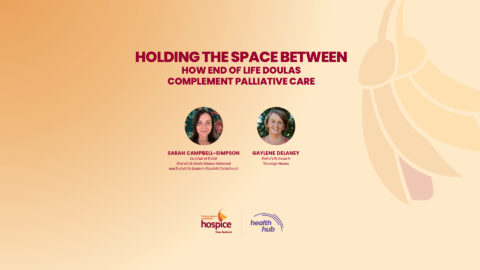
Explore how End of Life Doulas provide non-clinical, relational support across serious illness, dying, death, and bereavement. This session highlights their role alongside palliative care in Aotearoa New Zealand, supporting patients and whanau between clinical touchpoints.
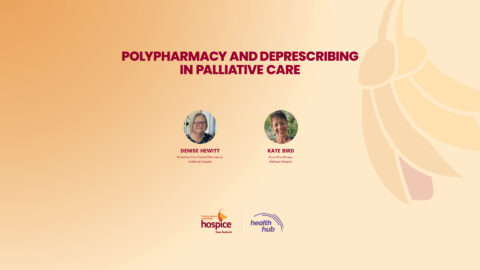
Polypharmacy is a growing patient safety concern in Aotearoa New Zealand. The risk of medication-related harm rises significantly when patients take five or more medicines—and currently, nearly 46.5% of people aged 65+ are prescribed ...
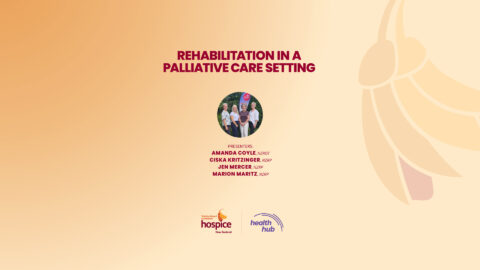
This session explored rehabilitation as a vital element of palliative care, carried out collaboratively by the full interdisciplinary team. The presenters discussed specific rehabilitative contributions that can enhance quality of life for patients receiving palliative care.
Ruth is a public health physician and epidemiologist who has worked in population mental health in academic and public service settings. Ruth led the HRC funded Tupuanuku research study which focused on physical health care quality and experiences of discrimination in health services for people ...
Dave moved to New Zealand from the U.S. nearly 10 years ago. He completed medical school in Wisconsin and then trained and became certified in Internal Medicine, Paediatrics and Palliative Medicine in Phoenix, Arizona. He has had multiple clinical, teaching and leadership ...
Dean is a Palliative Medicine Specialist working at Mercy Hospice in Auckland. He dual-trained as a General Physician and Palliative Medicine Physician and has an interest in clinical education. He is an Honorary Senior Lecturer in Medicine at ...
Drawn from the stories of Citizens Advice Bureau (CAB) clients and data from the CAB Death and Dying Spotlight Report (March 2025), this webinar offered insights into the common issues people seek CAB’s support with at the end of life ...
Stella (Ngai Tuhoe, Whakatohea, Te Whanau-a-Apanui, Ngati Whakaue) is a mama, partner, kaiwhakaruruhau-a-iwi, kairangahau, Kaituao and community volunteer. She is active in several Eastern Bay of Plenty trusts and is passionate ...
Originally from Kerry, Ireland, Florry attended university in Dublin, where he completed a physiology degree and a master’s in neuroscience alongside his medical studies. In 2010, he moved to New Zealand and went ...
This presentation examines the grief experiences of families following assisted dying, exploring anticipatory grief, caregiving roles, decision-making, stigma, and key psychological models that inform effective support ...
KA WHAI AWA, KA WHAI ARA LAUNCHING RESOURCES FOR YOUNG PEOPLE WITH A SERIOUS ILLNESS IN AOTEAROA
In this presentation members of the AYA Palliative Care Working Group shared insights into the collaborative development process, introduced the resources, and outlined the next steps for implementation ...
END OF LIFE NEEDS & CONSIDERATIONS FOR PEOPLE WITH DEMENTIA
Dr Michal Boyd is a nurse practitioner who works privately in residential aged care facilities with Equinox Health Ltd and holds Honorary Associate Professor position at the University of Auckland. Her main practice and research interests are care of older adults living with ...
SUPPORTING PEOPLE WITH INTELLECTUAL DISABILITIES IN END-OF-LIFE CARE
This presentation explores the experiences of tangata whaikaha and people with intellectual disabilities in end-of-life care. It covers access to community-based services, health inequities, barriers to quality care, effective strategies, and actions to improve outcomes for tangata whaikaha and whanau, emphasizing their perspectives and opportunities for change ...
MANAGING DIABETES IN PALLIATIVE & END-OF-LIFE CARE
This presentation will provide an overview of managing all types of diabetes in palliative care, including considerations at the end of life. It will cover approaches to new technology in type 1 diabetes, such as continuous glucose monitoring and insulin pump therapy, as well as recent medications in type 2 diabetes, including empagliflozin, dulaglutide, and liraglutide ...
Dr Peter Eastman is a clinician-researcher and Director of the Barwon Health Department of Palliative Care. Peter is heavily involved in medical education at both undergraduate and postgraduate levels and holds honorary appointments with both Deakin University and University of Technology Sydney ...